Silicone Resins in High-Temperature Coatings: What Do Methyl, Phenyl and Vinyl Groups Change?
Silicone resins are widely used as binders in high-temperature coatings. Compared with many conventional organic resins, they offer good resistance to heat, weathering and ageing, making them suitable for high-temperature coatings, industrial equipment and applications requiring long-term thermal stability.
But not all silicone resins behave in the same way.
The organic groups attached to the silicon atoms can change the molecular structure of the resin and, in turn, influence hardness, flexibility, thermal stability and the crosslinked network formed during curing.
Among the groups commonly encountered in silicone resin systems are methyl, phenyl and vinyl.
01|Methyl: A Balanced Property Profile
Methyl is one of the most common organic groups in silicone materials.
Silicone resins containing a high proportion of methyl groups generally have a relatively simple structure. The small steric size of the methyl group allows the siloxane backbone to retain good stability.
Combined with the relatively strong Si–O bonds, this structure contributes to good heat and weather resistance while maintaining a certain degree of flexibility.
For high-temperature coatings, methyl-based silicone resins are widely used, particularly in systems where heat resistance, weatherability and electrical insulation are important.
One of their characteristics is a relatively balanced property profile. They do not simply pursue high hardness at the expense of flexibility.
However, when a formulation requires higher hardness, chemical resistance or improved stability at elevated temperatures, methyl groups alone may not provide the desired balance. Other organic groups can then be introduced to modify the resin structure.
02|Phenyl: Influencing Rigidity, Hardness and Thermal Performance
Compared with methyl, the phenyl group is larger and more rigid.
Introducing phenyl groups changes the molecular structure, rigidity and thermal characteristics of the silicone resin. In many high-temperature coating systems, methyl-phenyl silicone resins are used to achieve a balance between heat resistance, hardness and mechanical properties.
As the phenyl content changes, properties such as hardness, flexibility, glass-transition behaviour and compatibility with other resins or formulation components can also change.
So, a higher phenyl content does not simply mean higher temperature resistance.
The actual choice needs to consider the operating temperature, required hardness, mechanical performance and curing conditions of the coating system.
03|Vinyl: Reactivity Is the Key
Vinyl groups have a somewhat different role compared with methyl and phenyl groups.
The main point of interest with vinyl is not simply its contribution to high-temperature resistance, but its reactivity. Vinyl groups can serve as reactive sites for further crosslinking.
In addition-cure silicone systems, vinyl groups can participate in the crosslinking reaction and therefore influence the network structure formed during curing.
This means that vinyl groups are closely related to the curing mechanism and crosslink density.
The degree and type of crosslinking, together with the compatibility of other reactive components, can subsequently affect the hardness, heat resistance, chemical resistance and mechanical properties of the cured coating.
Therefore, when a formulation contains vinyl-functional silicone components, it is important to look beyond the question of “how high a temperature can it withstand?” The role it plays in the overall curing system also matters.
04|How Should We Understand the Three Groups?
In simple terms:
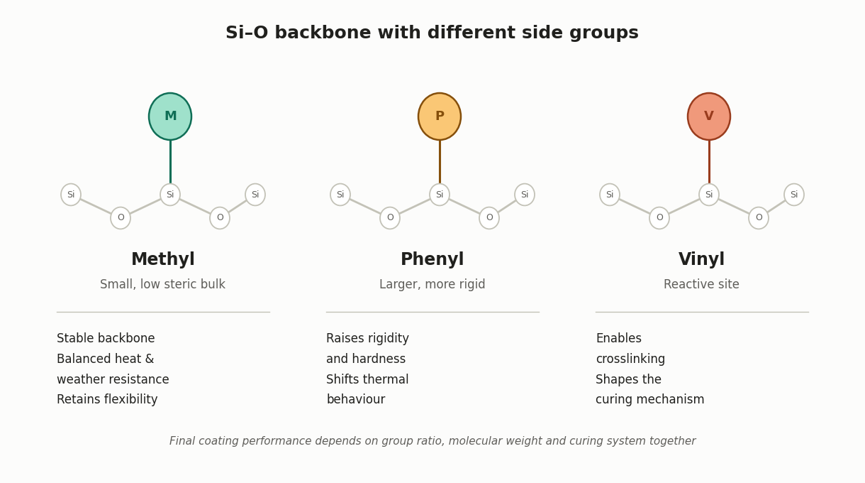
- Methyl mainly contributes to the basic heat and weather resistance of the silicone structure while helping maintain a certain degree of flexibility.
- Phenyl has a stronger influence on rigidity, hardness and thermal behaviour, and is often combined with methyl in high-temperature coating systems.
- Vinyl mainly provides reactive functionality and can participate in crosslinking in specific curing systems.
This does not mean that the three groups can simply be ranked as “better” or “worse”.
In practical silicone resin design, the final properties are rarely determined by one organic group alone. Different groups can be combined to achieve a suitable balance for a specific application.
The type and ratio of substituents are only part of the picture. Molecular weight, functionality, siloxane structure, curing mechanism and the other components in the formulation can all influence the final coating performance.
This is one reason methyl-phenyl silicone resins are commonly used in high-temperature coatings: the two groups can influence different aspects of resin performance, allowing the formulation to balance heat resistance, hardness, flexibility and long-term stability.
05|Choosing a Silicone Resin: Temperature Rating Is Not the Whole Story
When selecting a silicone resin for a high-temperature coating, the temperature rating is certainly important. But it does not tell the whole story about how a coating will perform under actual service conditions.
Coating thickness, pigments and fillers, curing conditions, resin compatibility and long-term thermal cycling can all affect the final performance.
Instead of simply asking whether methyl, phenyl or vinyl is “better”, it is more useful to first define what the coating actually needs to achieve:
- Is the application exposed to continuous high temperatures or short-term temperature peaks?
- Is hardness the priority, or is a certain degree of flexibility also required?
- Does the system use a conventional curing process, or does it rely on a specific reaction to form a crosslinked network?
Different requirements call for different structural approaches.
For silicone materials, performance is rarely determined by a single functional group. The practical approach is to match the resin structure and curing behaviour with the application and formulation requirements, and find the right balance between heat resistance, hardness, flexibility and curing performance.